Rewinding Tension Problems: Causes, Solutions, and Better Roll Quality
Rewinding tension plays an important role in the quality of finished rolls during slitting and converting. When tension is properly controlled, materials can be wound with consistent roll structure, stable edges, and suitable hardness for storage and further processing. However, incorrect or unstable tension may cause loose rolls, excessive hardness, telescoping, wrinkles, and other winding defects.
These problems are particularly noticeable when processing thin films, pressure-sensitive labels, paper, and laminated materials. Understanding how rewind tension changes during production can help operators improve roll quality, reduce waste, and maintain stable slitting performance.
Why Rewinding Tension Changes During Production
Unlike the unwinding process, where the master roll becomes smaller, the rewind roll continuously increases in diameter. As the roll grows, the torque required to maintain a given web tension also increases.
If the rewinding system does not compensate correctly for changing roll diameter, tension may become unstable. A fixed torque setting, for example, will generally produce lower web tension as the rewind diameter increases.
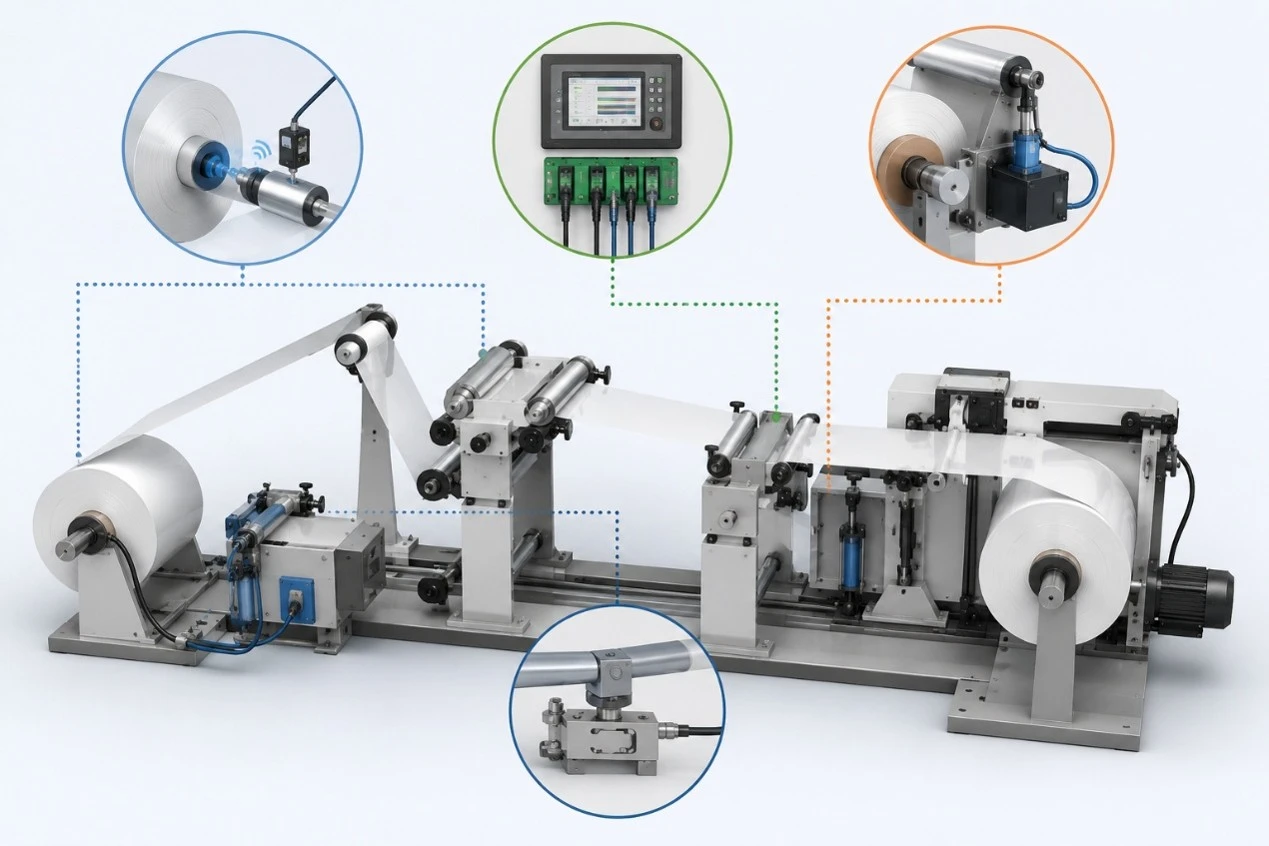
Modern slitter rewinders use different control methods to manage this relationship, including programmed torque control, diameter-based tension control, and closed-loop systems using load cells or dancer mechanisms.
The appropriate solution depends on the machine design, material characteristics, and required finished roll quality.
What Happens When Rewind Tension Is Too High?
Excessive rewind tension can create overly tight rolls and increase pressure between the wound layers. For certain materials, this may lead to deformation, wrinkles, adhesive-related problems, or damage to sensitive surfaces.
Thin plastic films can be especially sensitive to excessive tension. Depending on the material properties, high tension may cause stretching or contribute to distortion during winding. Pressure-sensitive label materials may also experience unwanted compression or other roll-quality problems.
A finished roll that feels very hard is not necessarily a good roll. Excessive hardness can make subsequent unwinding difficult and may affect material performance during printing, laminating, or die cutting.
When rolls become increasingly tight as diameter grows, operators should examine the rewind tension profile rather than simply reducing the machine speed.
Why Low Tension Causes Loose Rolls and Telescoping
Insufficient rewind tension can produce loose layers and unstable roll structure. Finished rolls may lose their shape during handling, develop uneven edges, or become difficult to transport and store.
Telescoping, where layers shift sideways and create a stepped roll profile, is sometimes associated with inadequate winding stability. However, low tension is not the only possible cause. Poor web alignment, uneven material thickness, trapped air, and incorrect winding conditions can also contribute.
Increasing tension may temporarily improve roll stability, but excessive adjustments can create new problems. The objective is to achieve sufficient layer stability without applying unnecessary pressure to the material.
Understanding Taper Tension in Rewinding
One important concept in rewind tension control is taper tension. Instead of maintaining exactly the same tension throughout the winding process, the system gradually reduces the target tension as roll diameter increases.
For many materials and winding applications, this helps prevent excessive internal pressure and overly hard outer layers as the roll grows.
However, taper tension is not suitable for every material in the same way. The required tension profile depends on film thickness, stiffness, surface characteristics, roll diameter, winding method, and downstream requirements.
A taper setting that works well for paper labels may not produce the same results with thin PET or BOPP film. Operators should therefore treat taper tension as an adjustable process parameter rather than a universal percentage.
When Multiple Narrow Rolls Wind Unevenly
Rewinding several narrow rolls simultaneously introduces another challenge. Small variations in material thickness, slit width, or roll diameter may cause individual rolls to develop different winding conditions.
When multiple finished rolls are driven by a common shaft, differences between rolls can affect tension distribution and roll hardness. One roll may become tighter while another remains relatively loose.
Differential rewinding systems, including suitable friction shafts, can help accommodate differences between individual rolls by allowing controlled relative movement and torque distribution.
However, differential winding performance still depends on correct settings, shaft condition, friction characteristics, and material requirements. It should not be assumed that every air-expanding shaft provides independent tension control for each finished roll.
For converters producing many narrow label rolls, selecting an appropriate rewinding configuration can be just as important as the slitting knife arrangement.
How to Identify the Real Cause of Rewinding Problems
When finished roll quality becomes inconsistent, operators should first determine whether the defect appears at the beginning of winding, develops as the diameter increases, or occurs only at higher speeds.
If the first layers are loose, check the initial tension, core gripping, and starting conditions. If the roll becomes excessively hard as diameter increases, review the torque compensation and taper tension settings.
When defects occur mainly during acceleration or deceleration, the tension control response and drive coordination may need attention. Sudden tension fluctuations can also result from slipping components, incorrect diameter calculation, sensor problems, or mechanical issues.
The incoming material should not be overlooked. Uneven thickness, poor master roll quality, lateral web movement, and wrinkles can produce winding defects even when the rewind tension system is functioning correctly.
Where available, tension readings and recorded production parameters can help identify the relationship between machine settings and finished roll quality.
Improving Rewind Tension Stability
A stable rewinding process begins with appropriate tension settings for the material and roll dimensions. Operators should verify the web path, shaft condition, core installation, and tension-control components before production.
Initial rolls should be inspected for hardness, edge alignment, surface condition, and winding stability. As production speed and roll diameter increase, the same quality indicators should be monitored.
Load cells, dancer rollers, and properly configured servo or torque-control systems can help maintain more consistent tension, depending on the machine configuration. Regular inspection and calibration of relevant sensors and mechanical components are also important.
For repeat orders, recording successful settings can reduce startup waste and improve consistency between production batches.
Choosing the Right Slitter Rewinder for Better Roll Quality
When purchasing a slitter rewinder, buyers should consider more than maximum machine speed and slitting width. The rewinding system must be suitable for the intended material, minimum slit width, maximum finished roll diameter, and number of rolls produced simultaneously.
Important questions include whether the machine supports suitable tension control, whether taper tension is available, and whether independent or differential rewinding is required.
For thin films, stable web handling and suitable winding control are particularly important. For narrow label rolls, the ability to maintain consistent winding conditions across multiple finished rolls may be a major consideration.
The best configuration depends on actual production requirements rather than one winding system being suitable for every application.
Final Thoughts
Rewinding tension problems are rarely solved by changing a single parameter. Roll diameter, torque control, taper tension, material properties, web alignment, and rewinding shaft design all influence finished roll quality.
By identifying when defects occur and understanding how tension changes during winding, operators can reduce loose rolls, excessive hardness, telescoping, and material waste. A properly configured rewinding system helps maintain consistent production quality without unnecessary adjustments.
Looking for a slitter rewinder with reliable winding performance? GGIN Machinery offers slitting and rewinding solutions with different tension-control and rewinding configurations. Share your material type, thickness, web width, minimum slit width, core size, and finished roll diameter, and we can help you evaluate a suitable machine for your production needs.