UV vs Water-Based Flexo Printing: Key Differences and How to Choose
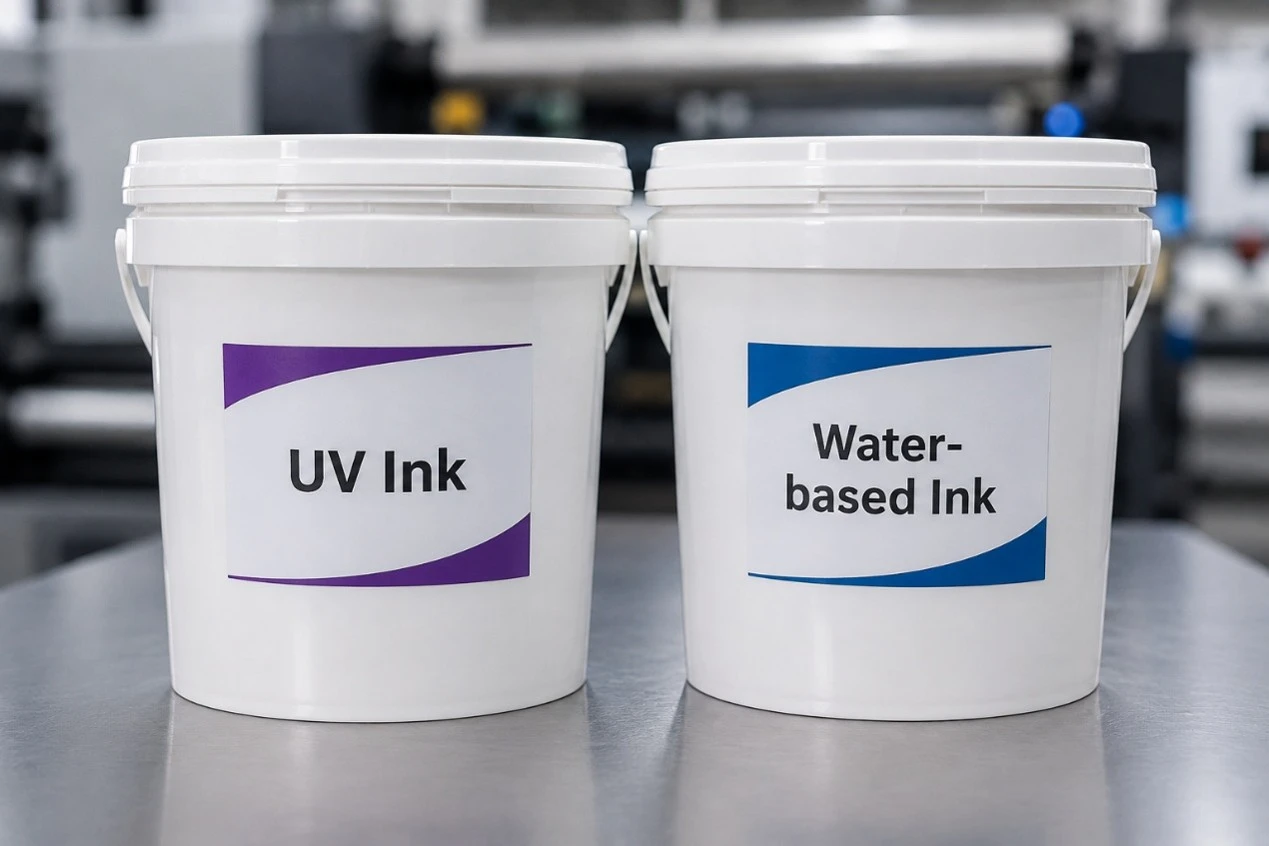
UV and water-based inks are both widely used in flexographic printing, particularly in label and packaging production. However, they behave very differently on press. Their drying mechanisms, substrate compatibility, ink transfer characteristics, production requirements, and equipment configurations all influence which system is more suitable for a particular application.
For a printer investing in a new flexographic press, the choice should not be based simply on whether UV or water-based ink is considered more advanced. A better approach is to start with the substrate, finished product, print quality requirements, production speed, downstream converting process, and available factory infrastructure.
The Main Difference Is Drying and Curing
Water-based flexo inks use water as a major part of the liquid carrier system. After printing, this liquid must be removed from the ink film, normally through a combination of heat, airflow, and exhaust. The effectiveness of the drying system therefore has a direct influence on achievable production speed and print stability.
UV ink works differently. It contains components that react when exposed to suitable ultraviolet energy, converting the printed ink film into a cured layer. Instead of depending mainly on evaporation, the press uses UV curing units after the relevant printing stations.
This fundamental difference affects machine design. A water-based flexo press needs sufficient hot-air drying capacity, while a UV flexo press requires suitable UV curing equipment. Neither system can be evaluated independently from the press configuration that supports it.
Where Water-Based Flexo Performs Well
Water-based flexo is particularly well established for paper, paperboard, corrugated packaging, paper bags, tissue products, and many other absorbent substrates. It is also used for certain film and label applications when the ink formulation and substrate surface are compatible.
On absorbent materials, water-based inks can provide good print quality without requiring UV curing equipment. This makes them attractive for many paper-based packaging applications.
Printing on non-absorbent films requires more attention. PET, BOPP, PE, and similar materials may need appropriate surface treatment, primers, or specially formulated inks to achieve reliable wetting and adhesion. Drying can also become more demanding because the substrate does not absorb the liquid portion of the ink.
For this reason, saying that water-based flexo is suitable for a material is not enough. The exact substrate construction, surface treatment, ink formulation, and drying requirements should be confirmed.
Why UV Flexo Is Common in Narrow-Web Label Printing
UV flexo has become an important technology for self-adhesive labels and other narrow-web applications. Fast curing makes it well suited to production lines where printing is followed immediately by processes such as varnishing, laminating, die cutting, slitting, or rewinding.
UV inks can provide strong color density and good reproduction of fine graphics, making them suitable for many high-quality label applications. Because curing takes place rapidly under the correct UV conditions, the printed web can move into downstream converting without requiring a long conventional drying section.
This does not mean UV ink works automatically on every substrate. Surface properties, ink formulation, anilox specification, ink film thickness, curing energy, and production speed still need to be matched correctly.
How Do They Compare in Print Quality?
Both technologies are capable of producing high-quality flexographic printing. The final result depends on much more than the ink category.
UV flexo is often selected for labels requiring strong color, fine graphics, small text, barcodes, and consistent reproduction. Water-based flexo can also achieve excellent results, particularly when the press, anilox specification, ink formulation, drying, and substrate are properly matched.
Anilox selection plays an important role in both processes because cell volume determines how much ink is available for transfer. The doctor blade system must then meter the anilox consistently. Excessive ink film can create drying or curing problems, while insufficient ink transfer can result in weak color or poor solid coverage.
Instead of asking which ink produces better quality in general, it is more useful to ask which system can deliver the required quality consistently on the intended substrate.
Drying Capacity Can Limit Water-Based Production Speed
One of the most important considerations with water-based flexo is drying capacity. As production speed increases, less time is available to remove moisture from the printed ink film. Heavy ink coverage and non-absorbent substrates can make this more difficult.
A press intended for higher-speed water-based printing therefore needs an appropriately designed drying system. Air volume, temperature, exhaust efficiency, web width, ink coverage, and substrate sensitivity all need to work together.
Simply increasing dryer temperature is not always the answer. Excessive heat can affect heat-sensitive films or create web-handling problems. Effective drying requires a balance between airflow, heat, exhaust, dwell time, and material properties.
UV Curing Has Its Own Production Requirements
UV flexo avoids conventional water evaporation, but the curing system must provide enough energy for the ink film at the selected production speed. Ink chemistry, lamp output, wavelength, anilox volume, ink coverage, and distance from the curing source can all influence the result.
Conventional UV lamps have long been used in flexographic printing, while LED UV systems are also available for compatible applications. LED UV can provide advantages such as instant switching and lower heat generation at the curing source, but suitable LED-curable inks are required.
If curing is insufficient, the solution should not automatically be to reduce speed or increase energy without investigating the complete process. Ink film thickness, lamp condition, ink compatibility, and machine settings should all be checked.
What About Color Stability?
Color consistency is important with both technologies, but the variables are somewhat different.
With water-based inks, evaporation during production can influence viscosity and ink behavior, so viscosity, pH where relevant to the ink system, temperature, and circulation may need regular control. Changes in these parameters can affect ink transfer and color density during a long production run.
UV inks do not lose water through evaporation in the same way, but temperature, ink condition, anilox cleanliness, doctor blade performance, and curing still influence production stability.
For either system, stable color depends on controlling the complete ink transfer process rather than relying on the ink technology alone.
Environmental Considerations Need a Broader View
Water-based ink is often promoted as the environmentally preferable option because it substantially reduces reliance on conventional organic solvents in many applications. However, water-based printing still requires energy for drying, and the exact environmental performance depends on ink chemistry, dryer efficiency, production conditions, waste handling, and the finished product.
UV inks contain little or no conventional volatile solvent compared with typical solvent-based inks, but they require curing energy and appropriate handling of uncured ink. The environmental profile also depends on the UV technology, ink formulation, production efficiency, waste management, and end-use requirements.
For printers evaluating sustainability, it is better to compare the complete printing process rather than judging an ink system from a single characteristic.
UV or Water-Based: Which One Fits Your Application?
| Factor | Water-Based Flexo | UV Flexo |
| Drying / curing | Hot-air drying and evaporation | UV curing |
| Common applications | Paper labels, bags, paper packaging, cartons | Self-adhesive labels, narrow-web packaging |
| Paper substrates | Very suitable for many applications | Suitable with compatible ink |
| Film substrates | Requires suitable ink/treatment/drying | Common in filmic label applications |
| Fine graphics | Good with correct setup | Strong option for detailed label work |
| Production limitation | Drying capacity can limit speed | Curing capacity can limit speed |
| Ink process control | Viscosity, temperature and sometimes PH | Temperature, ink condition and curing |
| Inline converting | Possible after adequate drying | Rapid curing is advantageous |
| Main press requirement | Effective hot-air dryer/exhaust | Suitable UV curing system |
For paper labels, paper packaging, bags, cartons, and other absorbent materials, water-based flexo can be a practical and efficient solution when the drying system is properly configured. It can also be used for selected film applications with suitable ink and surface treatment.
For narrow-web pressure-sensitive labels, especially jobs requiring fine graphics, rapid curing, and immediate inline converting, UV flexo is often an attractive option.
The decision becomes more application-specific when printing films. In this case, adhesion, surface treatment, heat sensitivity, finished-product requirements, ink availability, and production speed should all be evaluated through testing whenever possible.
There is therefore no universal winner between UV and water-based flexo. The better system is the one that matches the products a printer actually needs to manufacture.
What Should You Confirm Before Ordering a Flexo Press?
Before selecting the drying or curing configuration of a new flexographic printing machine, prepare representative samples of the materials you intend to print and define the expected printing width, number of colors, speed, graphics, ink coverage, and downstream processes.
It is also useful to consider future work. A press purchased primarily for paper labels may have very different drying requirements from one expected to handle filmic labels or flexible packaging.
Discussing these requirements with the machine and ink suppliers before finalizing the configuration can prevent a situation where the press has sufficient mechanical speed but the drying or curing system becomes the real production limitation.
Final Thoughts
UV and water-based flexo printing are not competing technologies with one universal winner. Water-based ink is well suited to many paper and packaging applications and can also be used on selected films with the correct formulation and drying conditions. UV flexo is particularly strong in narrow-web label production where rapid curing, high-quality graphics, and inline converting are important.
The most reliable choice starts with the application rather than the ink. Substrate, print quality, production speed, drying or curing requirements, downstream converting, factory conditions, and finished-product requirements should all be evaluated together before choosing a flexographic printing system.
Not sure whether UV or water-based flexo is the right choice for your production? GGIN Machinery provides flexographic printing solutions with different drying and curing configurations for label and flexible packaging applications. Send us your substrate, printing width, number of colors, ink type, required speed, and finished product, and we can help you evaluate a suitable flexo press configuration.