Flexographic Printing Process: From Plate Making to Finished Labels
The flexographic printing process is widely used to produce self-adhesive labels, flexible packaging, paper products, and other roll-to-roll printed materials. It uses flexible relief printing plates, anilox rollers, and controlled ink transfer to reproduce text, graphics, and colors on a variety of substrates.
Modern flexographic printing combines plate-making technology, accurate registration, web tension control, and suitable drying or curing systems. For label manufacturers, understanding each stage of production is essential for maintaining consistent print quality, reducing material waste, and improving efficiency.
This guide explains the complete process, from artwork preparation and plate making to printing, die cutting, and finished label rolls.
1. Artwork Preparation and Prepress
The flexographic printing process begins with artwork preparation. Before production, the design must be checked for printing dimensions, color separation, image resolution, and registration requirements.
For multi-color printing, artwork is separated into individual color components. Each color generally requires a corresponding printing plate, although the exact number of plates depends on the design and printing configuration.
Prepress preparation also considers trapping, screening, minimum line widths, and the distortion compensation required when flexible plates are mounted around printing cylinders.
Correct prepress settings help prevent dimensional errors, color misalignment, and unnecessary adjustments during press setup.
2. Flexographic Printing Plate Making
After artwork preparation, the next stage is producing the flexographic printing plates. Photopolymer plates are commonly used for label and packaging applications because they provide flexible printing surfaces with raised image areas.
Depending on the plate technology, image formation may involve traditional film-based exposure or digital imaging. For conventional solvent-washable photopolymer plates, production typically includes back exposure, main exposure, washing, drying, and post-exposure or finishing procedures.
These steps create the raised printing elements that will transfer ink to the substrate.
Plate thickness, relief depth, exposure conditions, and processing accuracy influence printing performance. Incorrect plate preparation can contribute to poor fine-detail reproduction, inconsistent printing pressure, and dimensional problems.
Different plate technologies require different processing equipment, so manufacturers should select a plate-making system compatible with their chosen photopolymer materials.
3. Plate Mounting and Registration Alignment
Once the printing plates are ready, they are mounted onto printing cylinders or sleeves using suitable double-sided mounting tape.
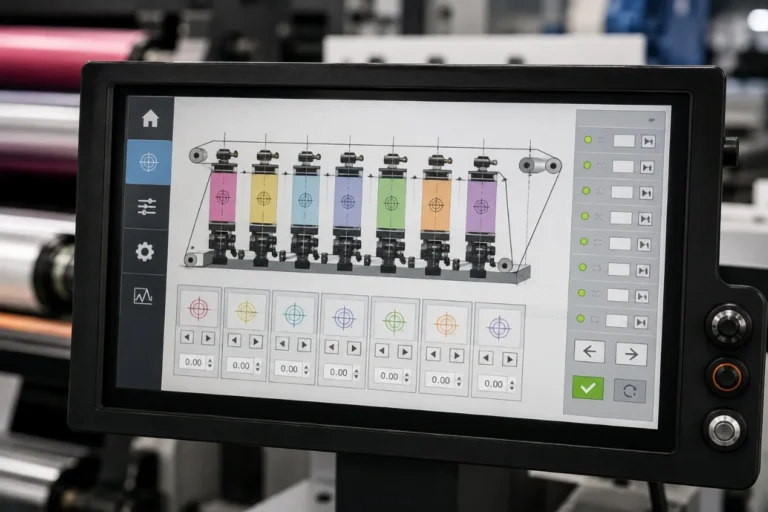
Accurate plate mounting is important because each printing color must align correctly with the others. Incorrect positioning may cause registration errors, increased setup waste, or additional adjustments on the printing press.
Manual mounting methods can be suitable for certain applications, while camera-assisted plate mounting machines help operators align registration marks more consistently.
Before mounting, the cylinder surface should be cleaned and inspected. Operators should also ensure that the mounting tape is applied evenly and that the printing plate is not stretched or distorted.
Good mounting practices help improve repeatability, particularly for multi-color label printing and frequent job changes.
4. Material Unwinding and Web Tension Control
The prepared printing cylinders are installed on the press, and the printing material is loaded onto the unwinding system.
Common substrates include self-adhesive labelstock, paper, PET, BOPP, and other films. Each material has different mechanical and surface characteristics, so the machine settings must be adjusted accordingly.
Web tension control keeps the material moving through the printing units under suitable tension. Excessive tension can stretch or deform sensitive substrates, while insufficient tension may lead to wrinkles, unstable web movement, and registration problems.
Web guiding systems help maintain lateral alignment during production.
For certain plastic films, surface treatment or verification of the treated printing side may also be necessary to achieve suitable ink adhesion.
5. Ink Transfer and Flexographic Printing
Ink transfer is the central stage of the flexographic printing process.
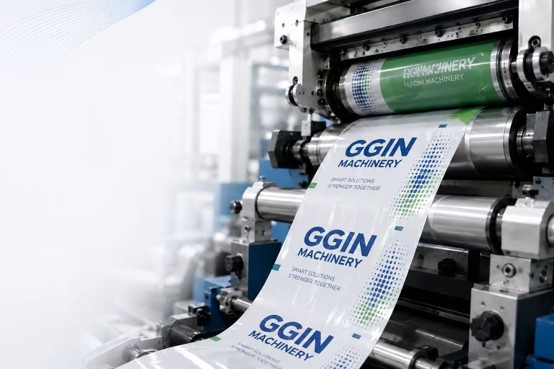
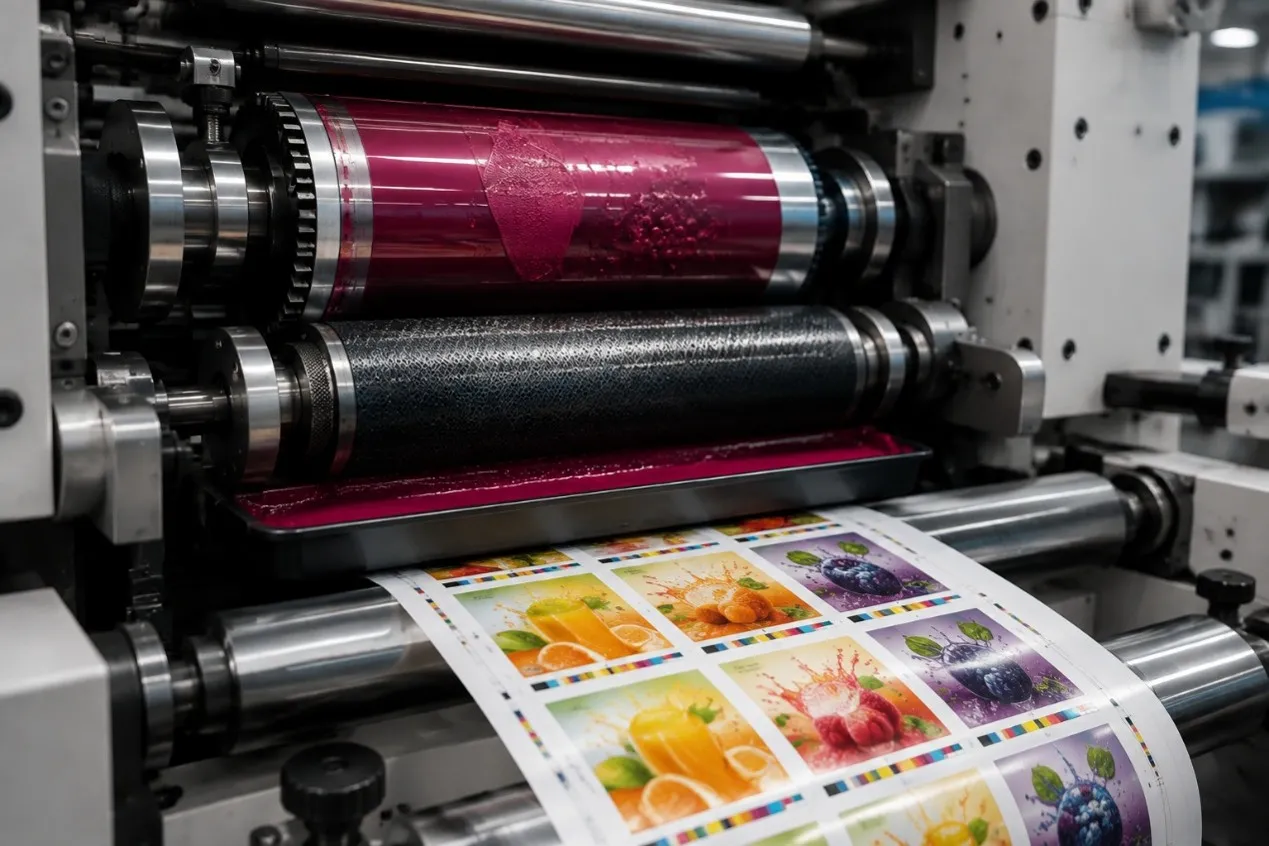
In a typical printing unit, the anilox roller delivers a controlled quantity of ink to the raised areas of the printing plate. The plate then transfers the ink onto the moving substrate under controlled printing pressure.
The engraved cell volume and line screen of the anilox roller influence ink delivery, color density, and image reproduction. Doctor blade systems help remove excess ink from the anilox surface and support consistent ink transfer.
For multi-color printing, the substrate passes through successive printing units. Accurate synchronization and registration control are required to keep the different colors aligned.
Printing quality depends on the combined performance of the anilox roller, plate, ink, substrate, printing pressure, and machine control system.
6. Ink Drying and UV Curing
After each printing stage, the ink must be dried or cured sufficiently before the material enters subsequent units or is rewound.
Water-based and solvent-based inks generally require suitable drying systems to remove volatile components. UV-curable inks use compatible UV curing equipment to initiate the curing process.
The correct system depends on the ink chemistry, substrate, printing speed, and application requirements.
Insufficient drying or curing may cause ink smearing, blocking, poor adhesion, or damage during downstream processing. Excessive heat can also affect temperature-sensitive films and contribute to dimensional instability.
For this reason, drying and curing capacity should be considered together with the printing speed and material characteristics.
7. Die Cutting and Label Finishing
After printing, label materials often require additional converting operations before they become finished products.
Rotary or semi-rotary die cutting is commonly used to produce the required label shapes. In pressure-sensitive label production, the cutting process must separate the face material and adhesive while leaving the release liner sufficiently intact.
Waste matrix removal then separates unwanted surrounding material from the finished labels.
Depending on the application, additional finishing operations may include varnishing, laminating, cold foil, hot stamping, or screen printing.
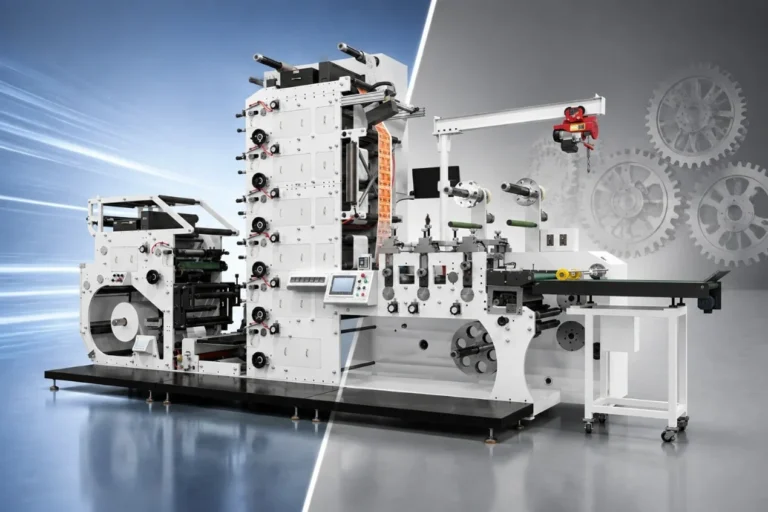
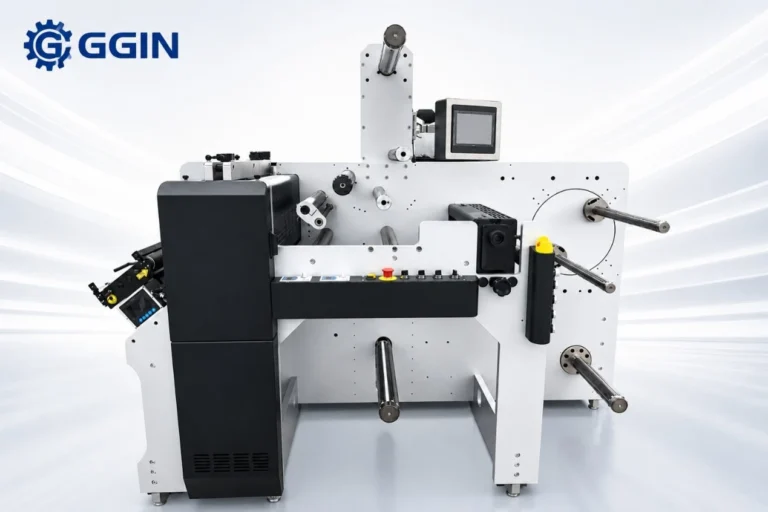
Some modular flexographic printing presses can be configured with inline finishing units, allowing printing and selected converting operations to take place in one production line. Other manufacturers use separate finishing equipment according to their production requirements.
8. Slitting, Inspection, and Rewinding
Once printing and die cutting are completed, the material is prepared for final roll production.
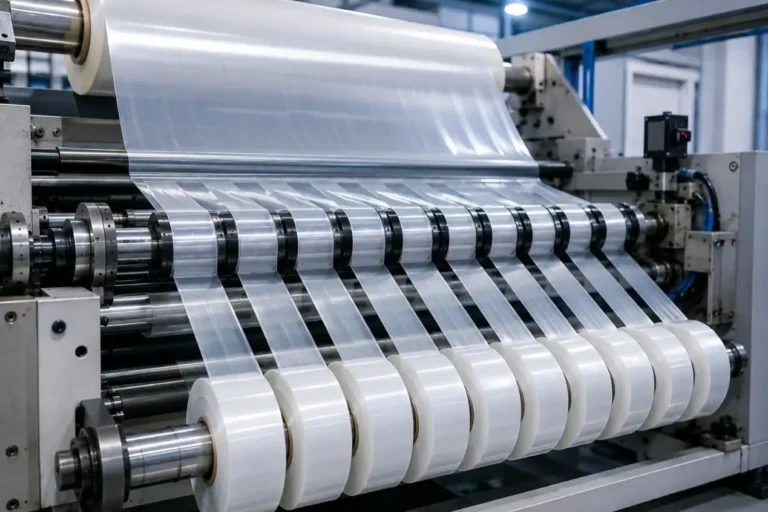
Slitting equipment divides the printed web into narrower widths according to the customer’s specifications. The finished label strips are then rewound onto suitable cores.
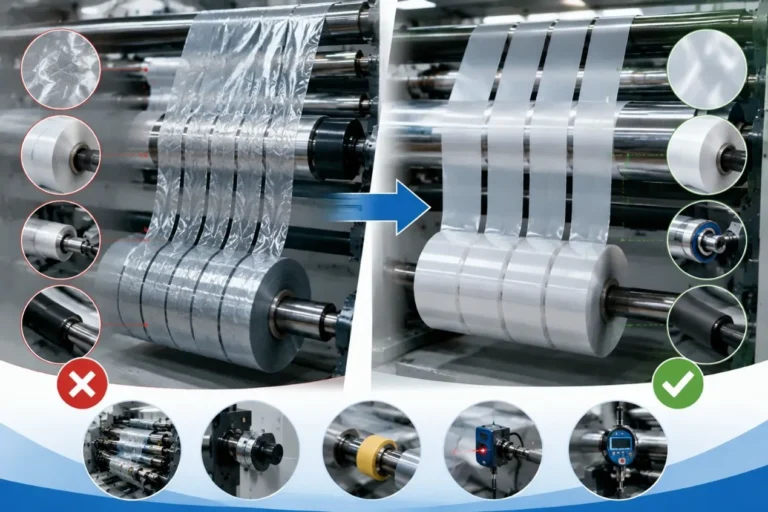
Proper rewinding tension is essential for producing stable rolls with consistent edges and appropriate hardness. Incorrect tension can cause loose rolls, telescoping, wrinkles, or material deformation.
Inspection rewinders may also be used to identify printing defects, remove unacceptable sections, and prepare finished rolls for delivery.
The required workflow depends on whether the labels are produced on an integrated printing and finishing line or processed through separate machines.
9. Quality Inspection and Finished Labels
Before delivery, finished label rolls should be checked against the approved production specifications.
Typical quality checks include color consistency, registration accuracy, print clarity, die-cutting quality, roll dimensions, and winding condition.
For certain applications, barcode readability, ink adhesion, and other performance requirements may also need to be verified.
Consistent quality inspection helps reduce customer complaints and ensures that finished rolls are suitable for subsequent labeling or packaging operations.
Choosing the Right Equipment for the Flexographic Printing Process
A reliable production workflow requires more than a printing press alone. Plate-making equipment, plate mounting machines, anilox rollers, drying systems, die-cutting equipment, and slitter rewinders all contribute to the quality of the finished product.
When selecting equipment, manufacturers should consider their materials, printing width, number of colors, required production speed, finishing operations, and available production space.
For businesses handling frequent label orders, a servo-driven modular flexographic printing machine with suitable inline finishing options may offer advantages in production flexibility. Other configurations may be more economical for simpler or more consistent production requirements.
The best solution depends on the complete production workflow rather than the specifications of an individual machine.
Final Thoughts
The flexographic printing process involves several connected stages, from artwork preparation and plate making to ink transfer, drying, die cutting, and rewinding. Each stage affects the quality and consistency of the finished labels.
Understanding these processes helps manufacturers identify production problems, select suitable equipment, and improve overall converting efficiency.
Looking for a flexographic printing or label converting solution? GGIN Machinery supplies flexo printing machines, plate mounting equipment, die-cutting machines, and slitter rewinders for different label and packaging applications. Share your material, printing requirements, and finished product specifications, and we can help you evaluate a suitable production configuration.