
How to Improve Slitting Accuracy: 10 Proven Ways to Achieve Better Slitting Results
Slitting accuracy is one of the most important factors in roll-to-roll converting. Whether processing self-adhesive labelstock, paper, PET, BOPP, PE, laminated materials, or other flexible substrates, inaccurate slitting can cause inconsistent roll widths, poor edges, web wandering, uneven winding, and unnecessary material waste.
Achieving better slitting accuracy depends on more than the knife itself. Web tension, knife positioning, web guiding, roller alignment, material quality, rewinding conditions, machine speed, and mechanical precision all influence the final result. This article explains ten practical ways to improve slitting accuracy and achieve more consistent finished rolls.
1. Set the Slitting Knives Accurately
Correct knife positioning is the foundation of accurate slitting. Even a small positioning error can create unacceptable width variation, especially when one master roll is divided into multiple narrow rolls.
Before production, verify knife positions according to the required finished widths and check the actual slit rolls after setup. For jobs that require frequent size changes, a clear knife-setting procedure and accurate measuring tools can reduce setup errors and improve repeatability.
2. Choose the Right Slitting Method
Different materials require different slitting methods. Razor slitting is commonly used for thin films, shear slitting provides clean and controlled cutting for many paper, film, and laminated applications, while crush cutting is suitable for certain paper and nonwoven products.
Using the wrong knife type can result in burrs, dust, rough edges, material deformation, or unstable cutting. The slitting method should therefore be selected according to substrate thickness, material structure, required edge quality, and production speed.
3. Maintain Stable Web Tension
Unstable web tension can cause the material to stretch, shrink, wrinkle, or move sideways before reaching the slitting section. Even if the knives are positioned correctly, the finished slit width may become inconsistent when the web itself is unstable.
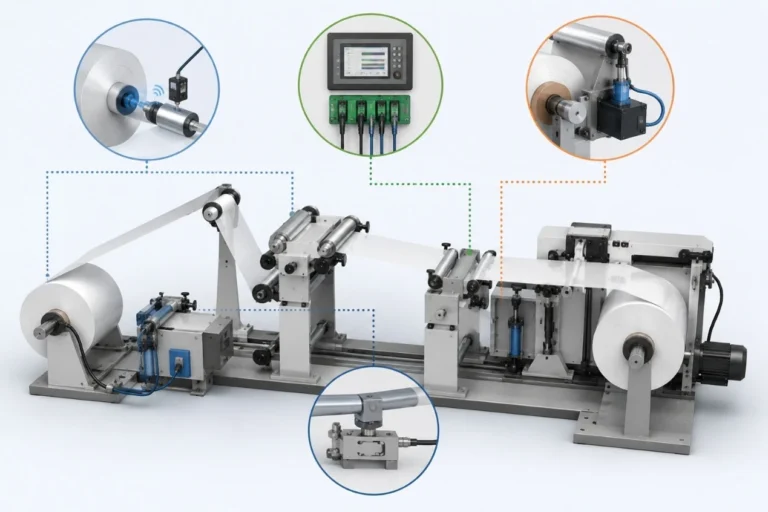
Tension should be matched to the material type, thickness, width, and machine speed. Closed-loop tension control can improve web stability from unwind through slitting to rewind, particularly when processing thin films and other tension-sensitive materials.
4. Use Accurate Web Guiding
A web guiding system keeps the material in the correct lateral position before it enters the slitting section. If the master roll moves sideways during production, the cutting position relative to the printed image or material edge may change.
Guide sensors should be properly positioned and calibrated, while the actuator should respond smoothly without excessive correction. Accurate web guiding is particularly important when slitting pre-printed labels or materials that require the slit line to follow a printed reference.
5. Check Knife Condition Regularly
Worn or damaged knives reduce both edge quality and cutting consistency. A dull blade may pull or deform the material instead of cutting it cleanly, resulting in burrs, dust, rough edges, or width variation.
Inspect knives regularly and replace or sharpen them according to their condition and the material being processed. Knife overlap, side pressure, and clearance should also be correctly adjusted when using shear slitting systems.
6. Keep Rollers Properly Aligned
Guide rollers, nip rollers, and other web-handling components must remain parallel. Roller misalignment can create uneven cross-web tension and cause the material to move away from its intended path.
If slitting accuracy is consistently different between the operator side and drive side, or if diagonal wrinkles appear, roller alignment should be inspected before repeatedly adjusting knife positions. Bearings and roller surfaces should also be checked for wear or contamination.
7. Control Rewinding Tension
Slitting does not end when the material passes through the knives. Poor rewinding can make accurately slit material appear defective because rolls may telescope, become too loose or too hard, or develop uneven edges.
Proper rewind tension and taper tension help maintain stable roll structure as the diameter increases. When multiple narrow rolls are rewound simultaneously, differential rewinding may also help compensate for small variations in thickness and roll diameter.
8. Check the Quality of the Master Roll
Sometimes the source of inaccurate slitting is the incoming material rather than the machine. Uneven roll edges, thickness variation, poor winding, telescoping, or inconsistent material properties can make precise web control more difficult.
Before adjusting the slitter extensively, inspect the master roll and compare it with a known good material. This is particularly useful when a machine performs accurately with one batch but develops repeated problems with another.
9. Use the Right Production Speed
A slitting machine may produce excellent results at moderate speed but lose accuracy when running too fast. Higher speed increases the demands on tension control, web guiding, knife stability, and rewinding.
Increase speed gradually and monitor slit width, edge quality, web position, and finished roll condition. The best production speed is the highest speed at which the machine can consistently maintain the required accuracy and roll quality, rather than simply the maximum speed listed in the specification.
10. Maintain the Machine and Standardize Job Settings
Mechanical wear gradually affects slitting accuracy. Worn bearings, loose knife holders, damaged shafts, inaccurate sensors, or unstable tension components can create small errors that become increasingly noticeable during production.
Preventive maintenance should therefore include the knife system, rollers, bearings, shafts, tension sensors, web guide, unwind, and rewind sections. For repeat jobs, record successful knife positions, tension settings, production speed, material specifications, and rewind parameters. Standardized settings reduce trial-and-error adjustments and improve repeatability between operators and production runs.
How to Check Slitting Accuracy
Finished roll width should be measured at multiple positions rather than checking only one roll or one point. Operators should also inspect slit edges, roll alignment, winding hardness, and whether the material remains stable during acceleration and deceleration.
If width variation appears during production, determine whether the problem originates from knife positioning, lateral web movement, material stretching, mechanical runout, or winding behavior. Correctly identifying the source is more effective than repeatedly moving the knives to compensate for another problem.
How Modern Slitter Rewinders Improve Accuracy
Modern servo-driven slitter rewinders combine precise tension control, automatic web guiding, stable drive systems, and controlled rewinding to improve process consistency. These features are especially valuable for narrow-width products and applications where small variations can affect downstream printing, die cutting, labeling, or packaging operations.
However, machine automation cannot completely compensate for incorrect knife settings, poor-quality materials, worn components, or unsuitable operating parameters. High slitting accuracy is achieved when machine precision, process control, tooling, and material quality work together.
Conclusion
Improving slitting accuracy requires more than positioning the knives correctly. Stable web tension, accurate web guiding, suitable slitting methods, sharp knives, aligned rollers, controlled rewinding, consistent materials, appropriate production speed, and preventive maintenance all contribute to better results.
By controlling these factors systematically and recording successful settings for repeat jobs, converters can achieve more consistent slit widths, cleaner edges, better finished rolls, and lower material waste. A properly configured slitter rewinder with reliable tension and web control provides the foundation for accurate and efficient roll-to-roll converting.